 how-to
7 Steps to Prepare a Hampton Roads Rental for Hurricane Season
Last Updated: November 12, 2026
Quick Summary
To prepare a Hampton Roads rental for hurricane season, work through a written landlord checklist covering exterior, supplies, communication, and documents before the season peaks. Clear gutters and roof debris, trim trees, stock a disaster supply kit, send tenants a written hurricane notice, and photograph the unit's condition. Then confirm insurance, identify the property's evacuation zone and flood risk, and book a free rental property inspection.
- Forecasters expected 6 hurricanes this season, including 2 major storms with winds of 111 mph or higher.
- Skipping the dated photo walkthrough is the mistake that costs the most without before photos.
- Build one disaster supply kit per unit with one gallon of drinking water per person per day.
- Ask tenants to send storm damage photos and a written description within 24 to 48 hours.
- Store documentation in the cloud using file names like YYYY-MM-DD_room-or-area_description.
Table of Contents
- Start With a Hurricane Preparedness Checklist for Landlords
- Secure the Exterior of Your Hampton Roads Rental
- Stock the Property With a Disaster Supply Kit
- Use a Landlord Hurricane Communication Template
- Set Expectations for Hurricane Preparation for Tenants
- Know Your Evacuation Zone, Flood Risk, and Storm Surge Exposure
- Keep Rental Property Storm Damage Documentation
- Book a Free Rental Property Inspection Before the Season Starts
- Frequently Asked Questions
Start With a Hurricane Preparedness Checklist for Landlords
A hurricane preparedness checklist for landlords is a written list of property, tenant, and paperwork tasks completed before storm season peaks.
Owners who prep early spend the season answering questions. Owners who wait spend it paying for damage.
Below, we'll show you exactly how to prepare a Hampton Roads rental in seven steps, from the checklist to the free inspection.
What Goes in the Landlord Checklist
The landlord checklist covers four buckets: exterior, supplies, communication, and documents. Keep it short enough to actually finish.
- Clear gutters, downspouts, and roof debris
- Trim trees and secure outdoor furniture
- Stock a disaster supply kit inside the unit
- Send a written hurricane notice to tenants
- Confirm insurance coverage and store documents in the cloud
- Identify the property's evacuation zone and flood risk
- Photograph the unit's condition before the season
Watch out: skipping the photo walkthrough is the mistake that costs the most. Without dated "before" photos, you cannot prove pre-existing wear versus storm damage at move-out or in a claim.
Secure the Exterior of Your Hampton Roads Rental
Exterior prep is the highest-value work a landlord can do, and most of it costs time, not money. Wind and water find the weakest point first.
Roof, Gutters, and Downspouts
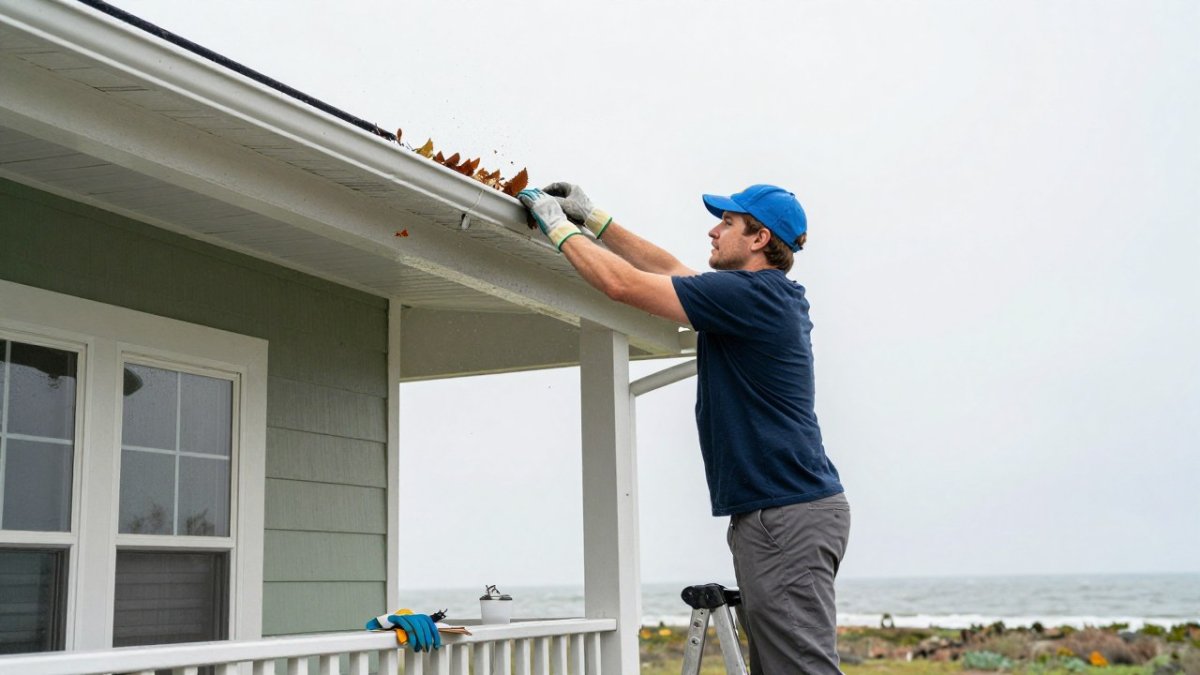
Start at the top. Loose or damaged shingles lift in wind, and clogged gutters push water into fascia and siding. Clear every downspout and confirm water runs away from the foundation, not toward it. If you are not comfortable on a ladder, hire it out. A fall costs more than a gutter cleaning.
Windows, Doors, and Loose Outdoor Items
Windows and doors fail at the seals. Check caulking, replace worn weatherstripping, and confirm tenants know how to install any storm panels you supply. Then walk the yard: grills, planters, trash bins, and patio furniture become projectiles in high wind. Ask tenants to bring loose objects inside when a storm is named.
Proactive care prevents the expensive stuff. Our guide on proactive property maintenance explains how small repairs now avoid five-figure bills later.
Stock the Property With a Disaster Supply Kit
A disaster supply kit is a stocked set of water, food, light, and medical supplies that lets tenants shelter safely for several days without power or running water. Build one kit per unit and tell tenants where it lives.
Stock these basics:
- Drinking water, one gallon per person per day
- Non-perishable food and a manual can opener
- Flashlight and extra batteries
- First aid supplies and a 7-day supply of medication
- Hygiene and sanitation supplies
- Battery-powered or hand-crank radio
- Phone chargers and a power bank
Seal the kit in a plastic bin. Check it each spring and replace anything expired. A kit that fails on inspection is worse than no kit, because tenants counted on it.
Use a Landlord Hurricane Communication Template
A landlord hurricane communication template is a pre-written message you send tenants before, during, and after a storm. It sets expectations, reduces panic calls, and creates a paper trail. Here is the version we use as a starting point:
Subject: Hurricane season prep for [property address]
Hi [tenant name],
Storm season is here. A few things to know:
- Before a storm: Bring outdoor items inside and charge your devices. Report any leaks, loose shingles, or broken seals to [maintenance contact] by [date].
- If an evacuation order is issued: Follow it. Do not stay in the unit to protect property. Your safety comes first.
- During the storm: Report emergencies to [emergency line]. Non-urgent issues can wait until it is safe.
- After the storm: Do not attempt repairs yourself. Send photos to [email] and we will schedule a visit.
Keep this message handy. Reply with any questions.
[Your name], [property manager]
Before you send anything, confirm your language matches your legal duties. Our overview of Virginia landlord-tenant laws covers disclosures, rights, and responsibilities.
Set Expectations for Hurricane Preparation for Tenants
Hurricane preparation for tenants works best when both sides know their role before the first named storm. Spell it out in writing at lease signing and again each spring, and keep a signed copy in the unit file.
What Tenants Typically Handle
- Bringing in loose outdoor items (grills, planters, trash bins, patio furniture)
- Stocking personal medication, documents, and pet supplies
- Following evacuation orders and keeping the landlord informed of their location
- Reporting damage quickly with dated photos and a written description
- Not attempting repairs themselves, especially anything involving utilities
What Landlords Typically Handle
- Structural repairs, roof condition, and exterior envelope (windows, doors, seals)
- Supplying and maintaining the disaster supply kit
- Sending storm notices and maintaining an emergency contact line
- Filing insurance claims and keeping the documentation file
- Coordinating licensed contractors for post-storm repairs
Virginia law does not spell out every hurricane-specific duty, so the lease is where you close the gaps.
Watch out: assuming a tenant knows what "emergency maintenance" means. Define it in the lease, active water intrusion, no heat or power, a broken exterior door or window, and give tenants a phone number and an email address for each. A tenant who cannot reach anyone will call a contractor and send you the bill.
Document the Handoff in Writing
Every spring, send a short written notice that restates the split and asks tenants to confirm receipt. Keep the confirmation. If a dispute arises after a storm, that dated acknowledgment is the difference between a conversation and a claim.
If a storm hits mid-lease and a tenant needs emergency repairs, our guide on emergency maintenance for rentals walks through the response sequence and the documentation you should keep at each step.
Know Your Evacuation Zone, Flood Risk, and Storm Surge Exposure
Evacuation zones and flood risk are the two facts every landlord should know before June. Storm surge, not wind, drives most hurricane deaths and much of the flooding damage in this region.
Look up the property's zone through your local emergency management office and note the nearest evacuation route. The Hampton Roads Planning District Commission tracks regional storm updates each season.
Household vulnerability changes how people respond to evacuation orders. A 2023 case study on hurricane logistics found that households differ in whether they stay, seek shelter, or evacuate, and those differences shape logistics planning. A 2020 Old Dominion University study examined evacuation behavior across several local cities, and the takeaway is simple: tenants need clear instructions, not assumptions.
If your tenants are military and relocating, our military relocation management steps cover how storm disruption fits into a move.
Keep Rental Property Storm Damage Documentation
Rental property storm damage documentation is the dated record of a unit's condition before, during, and after a storm. It protects three things at once: your deposit handling, your insurance claim, and your move-out process. Most landlords keep some photos; few keep a file organized well enough to hand to an adjuster or a judge without sorting through it first. A dated, organized record also makes it easier to compare storm-preparation decisions across properties, including the steps Galt Insurance discusses for a Naples home.
Build the File in This Order
| Stage | What to Capture | Why It Matters |
|---|---|---|
| Before season | Photos of every room, roof, and exterior; a written inventory of major systems and appliances | Proves pre-existing condition and establishes baseline value |
| Pre-storm | Copy of the tenant notice sent, kit inspection log, and any pre-storm contractor work | Shows reasonable care and notice |
| During storm | Tenant photos and timestamps, plus any messages reporting damage | Supports the claim with contemporaneous evidence |
| After storm | Contractor estimates, receipts, and a written scope of work | Backs the repair cost and prevents scope creep |
| Move-out | Side-by-side comparison to the "before" set | Defends deposit decisions and normal wear-and-tear calls |
Use a File-Naming Convention That Survives a Claim
Store everything in the cloud with dates in the file names. A workable pattern is YYYY-MM-DD_room-or-area_description, so a photo of the kitchen ceiling becomes 2026-06-01_kitchen-ceiling_water-stain.jpg. Paper files flood; cloud files do not. Keep a single folder per property and a single subfolder per storm event so an adjuster can follow the timeline without a walkthrough.
Report Damage in Writing, Promptly
After a storm, ask tenants to send photos and a written description to a dedicated email address within a set window, 24 to 48 hours is common. Acknowledge receipt in writing and log the date.
Watch out: relying on text messages alone. Screenshots get lost, phones get replaced, and threads get deleted. Copy any text-message report into the property file as a dated PDF the same day.
Connect the File to the Insurance Claim
Your insurance carrier will ask for the date of loss, a description of the damage, and proof of the pre-storm condition. The file you built in the spring answers all three. Keep receipts for any mitigation you pay for, board-up, water extraction, tree removal, because those costs are often reimbursable and always easier to recover when documented at the time.
If you are preparing a unit for the season, a yearly rental inspection is the simplest way to start the file with a professional baseline.
Book a Free Rental Property Inspection Before the Season Starts
An inspection before the season starts catches the problems a tenant will not report: a soft roof deck, a cracked seal, a downspout running into the foundation.
Out-of-state owners get the most from it.
Storm season does not wait for a convenient week. The landlords who sleep well are the ones who cleared the gutters in May and sent the tenant notice in June.
First Providence Realty is a minority-owned property management company built for first-time landlords.
Frequently Asked Questions
What's the worst month for hurricane season in Hampton Roads?
The Atlantic hurricane season runs from June 1 through November 30, and activity usually peaks from mid-August through late October. For a Hampton Roads rental, aim to finish exterior prep and tenant communication before mid-August so the property is ready when the peak window arrives.
When should landlords start preparing a rental for hurricane season?
Start in May, before the June 1 opening of the season. Use the early window to inspect the roof, clear gutters and downspouts, trim trees, and confirm insurance coverage. Then send the first tenant communication in late May or early June so hurricane preparation for tenants is not a last-minute scramble. A landlord who waits for a named storm to form is competing for supplies, contractors, and tenants' attention all at once, which is when small tasks turn into expensive ones.
Does renters insurance cover hurricane damage to a tenant's belongings?
Renters insurance typically covers a tenant's personal property, and hurricane damage may be covered, but wind and flood damage are often treated differently. Standard policies frequently exclude flooding, which is why tenants in Hampton Roads flood zones should ask about separate flood coverage. Landlords should require renters insurance in the lease and remind tenants to review their policy before the season. The building itself is the landlord's insurance responsibility; the tenant's belongings are theirs.
What should a landlord document before a hurricane hits a rental property?
Photograph and video every room, the exterior, the roof, and any pre-existing damage, and store the files in the cloud with a date stamp. Keep the lease, insurance policy, tenant contact list, and vendor contacts in one shared folder. Rental property storm damage documentation done before the storm is what supports an insurance claim and a fair move-out inspection afterward.