 blog
How to Vet a Property Manager Before You Sign
Last Updated: November 7, 2026
Quick Summary
Ask a property manager seven things before signing: how long they have managed properties like yours, their written process when a tenant stops paying, the full fee schedule beyond the monthly rate, and the agreement's term, renewal, cancellation, and spending-cap terms. Also ask how often you receive reports, how they screen tenants and market vacancies, and how your funds and insurance are handled.
- Ask for years of experience with your property type, not just years in business.
- A strong manager explains late rent in a written, step-by-step process.
- Get the full fee schedule in writing, since a low monthly rate can hide add-ons.
- Put the renewal notice window on your calendar the day you sign.
- Get a dollar cap in writing for what the manager can spend without approval.
Table of Contents
- Why the Questions You Ask a Property Manager Decide Your Returns
- Questions to Ask a Property Management Company Before Hiring
- Property Management Fees and Services: What the Fee Schedule Really Covers
- Property Management Agreement Terms You Should Never Sign Without Reading
- Property Manager Communication and Reporting: How You Stay in the Loop
- Tenant Screening and Vacancy Marketing: How They Fill and Protect Your Unit
- Owner Access, Funds Handling, and Insurance: The Questions Most Owners Forget
- Comparing Property Management Companies Side by Side
- Frequently Asked Questions
Why the Questions You Ask a Property Manager Decide Your Returns
The right questions to ask a property manager before signing do more than fill a checklist. They reveal how a company handles money, tenants, and repairs once your name is on the lease. This guide from First Providence Realty covers the seven questions that separate a real partner from a call center.
Here is the core idea. A property manager controls decisions that cost you money every week. Small choices about screening, late rent, and vendor calls add up fast. The questions you ask now show you how those choices get made later.
Ask first. Sign second.
Questions to Ask a Property Management Company Before Hiring
Start with two questions that tell you the most about day-to-day operations. One covers experience. The other covers the hardest part of the job: a tenant who stops paying.
How Long Have You Managed Properties Like Mine?
Ask for years of experience with your property type, not just years in business. A company that runs large apartment buildings may not know single-family homes. Ask how many units they manage and how many look like yours.
Push for details:
- How many single-family homes do you manage now?
- Do you handle Section 8 or military tenants?
- How many owners have left you in the past year?
The answers show whether your property fits their daily work.
What Happens When a Tenant Stops Paying?
A strong manager walks you through a written process, step by step. Ask when they send the first notice, who files the court paperwork, and who pays the legal fees. Ask how they handle a partial payment.
The answer should be specific, not "we handle it." A manager with a real process can explain it in plain words. One without a process will stall. For a closer look at late rent options, see how to handle late rent payments without losing your tenant.
Property Management Fees and Services: What the Fee Schedule Really Covers
A low monthly rate means little if extra charges pile up. Ask for the full fee schedule in writing before you compare property management fees and services. The base rate is only one line on a longer list.
The Monthly Fee Versus the Full Fee Schedule
Ask what the monthly fee covers and what costs extra. Common add-ons include:
- Leasing fees for each new tenant
- Renewal fees when a lease rolls over
- Markups on repairs and vendor work
- Eviction filing and court costs
- Inspection and statement fees
Then ask which fees are tax deductible. Our guide to property management fee tax deduction rules covers what landlords often miss.
Watch out: a low monthly rate with a leasing fee on every turn can cost more than a higher flat rate. Run the math on a full year.
Property Management Agreement Terms You Should Never Sign Without Reading
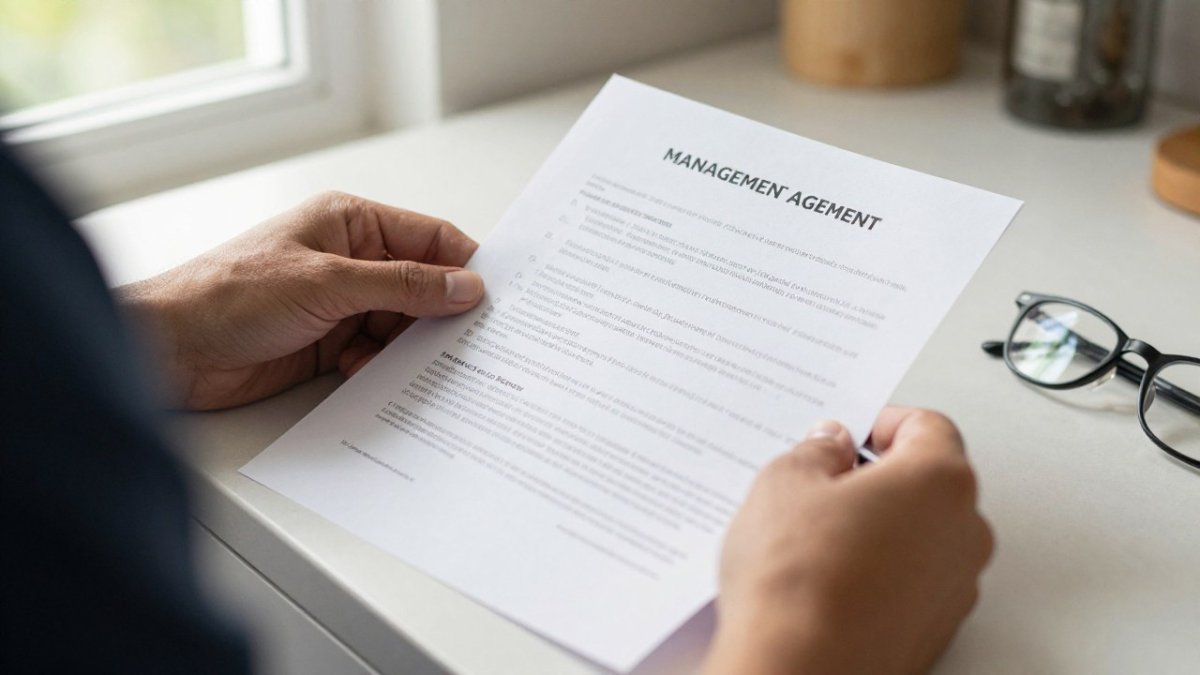
The management agreement is the contract that controls your money and your property, and it is the document the keyword is really about. Most owners skim it because the fee schedule looks familiar. Read every line before you sign, and read it against the questions below. The terms you skip are the terms that cost you later.
Term, Renewal, and Cancellation
Ask how long the initial term runs and what happens at the end. A common pattern is a one-year term that renews automatically unless you give written notice 30 or 60 days before the anniversary. Put the notice window on your calendar the day you sign, because missing it can lock you in for another full year.
Then ask three specific questions about exit:
- Notice to cancel: How many days' written notice must you give, and to whom?
- Early termination fee: Is there a penalty for leaving before the term ends, and is it a flat fee or a percentage of remaining management fees?
- Post-termination obligations: What happens to leases you signed while the manager was in place, and who collects rent after you leave?
Watch out: some agreements let the manager keep managing tenants it placed even after you cancel, which can leave you paying two managers at once.
Spending Limits and Owner Approval
Ask what the manager can spend without your approval and get a dollar cap in writing. Many owners set a per-item limit and a separate monthly aggregate limit, so a series of small repairs cannot quietly exceed your budget. Ask how they reach you for approval above the cap, how fast you must respond, and what they do if you do not respond, some contracts treat silence as consent.
Ask specifically about emergency spending. A burst pipe at 2 a.m. may justify a higher cap than a routine repair, but the contract should state that number and require receipts. Ask whether the manager can hire affiliated vendors and whether those vendors are disclosed.
Fees, Deposits, and Funds Language
Ask for the complete fee schedule as an exhibit to the agreement, not a separate sheet that can be revised later. Confirm in the contract which party holds security deposits, which account rent is deposited into, and when owner draws are paid. The agreement should require a separate trust or escrow account for client funds and should state how statements and invoices are delivered.
Insurance, Liability, and Indemnification
Ask who carries what coverage and get proof before signing. At minimum, confirm the manager carries general liability and errors-and-omissions coverage, and ask whether you are named as an additional insured. Then read the indemnification clause: it should not require you to cover the manager's own negligence, and it should be mutual where possible. Ask how claims are reported and who handles communication with your insurer.
What Should Be Documented Before You Sign
Before the pen touches paper, confirm you have: the full agreement with all exhibits, the complete fee schedule, the spending caps, the cancellation and renewal terms, the insurance certificates, and a written description of the reporting you will receive. If any of these is missing, ask for it in writing. A manager who cannot produce them before signing will not produce them after.
Property Manager Communication and Reporting: How You Stay in the Loop
Ask how often you get reports and through what channel. A good manager sends monthly financial statements and year-end tax documents without you asking. Ask to see a sample statement.
Ask these questions:
- How fast do you reply to owner emails or calls?
- Do I get an owner portal to see statements and work orders?
- Who is my main contact, and who covers for them?
For a benchmark on what good communication looks like, read key practices of a great property manager. If a company cannot answer these plainly, expect silence after signing.
Tenant Screening and Vacancy Marketing: How They Fill and Protect Your Unit
Ask what tenant screening steps they run before anyone signs a lease. A solid process includes a credit check, background check, rental history, and income review. Ask who makes the final call: the manager or you.
Then ask about vacancy marketing. How do they list the unit, how do they set market rent, and how long do units sit empty on average? A manager who tracks vacancy rate and occupancy rate can give you real numbers.
Ask how they handle lease enforcement and tenant retention. Fewer turnovers mean fewer leasing fees and less downtime.
Owner Access, Funds Handling, and Insurance: The Questions Most Owners Forget
Ask how your money is handled. Rent and deposits should sit in a separate trust account, not the company's operating account. Ask for the process for owner draws and how fast they pay out.
Then cover insurance and liability. Ask who carries coverage, what it protects, and how claims get reported. Ask how they handle a maintenance request that turns into an emergency at night. Get the 24/7 response process in writing.
Also ask about data access. Can you see your own records, and can you export them if you leave?
Comparing Property Management Companies Side by Side
Use one scoring sheet for every company you interview. Rate each answer from 1 to 5 and weight the sections that matter most to you.
| Question Area | What to Look For | Weight |
|---|---|---|
| Experience and unit fit | Manages homes like yours | High |
| Late rent and eviction process | Written, step-by-step process | High |
| Fee schedule | Full list, no surprise add-ons | High |
| Agreement terms | Clear spending cap and exit terms | High |
| Reporting and communication | Monthly statements, owner portal | Medium |
| Screening and marketing | Credit, background, and rental history checks | Medium |
| Funds and insurance | Separate trust account, clear coverage | Medium |
To build your shortlist, see our list of the best property management companies in Hampton Roads. If you are still deciding whether to hire at all, our guide to hiring a property manager vs. self-managing lays out both paths.
At First Providence Realty, we work with first-time landlords and small portfolios. Get in touch with us today and see how a minority-owned team approaches your property.
The seven questions above take about an hour to ask and can save you years of headaches. If you want straight answers and a team that treats your single unit like a real investment, First Providence Realty is ready to help. We offer full-service management with marketing, screening, and eviction protection, plus a Maintenance Partner Program for owners who only need repairs handled. Get started with First Providence Realty and put your property in steady hands.
Frequently Asked Questions
What should I ask a property manager before hiring them?
Start with the questions that affect your money and control: how they screen tenants, what the full fee schedule includes beyond the monthly percentage, how quickly they respond to maintenance requests, and what spending limit triggers owner approval. Ask for a sample owner report and a copy of the management agreement to review before signing. A property manager who answers these in specifics, not generalities, is usually the one worth hiring.
What fees should I expect beyond the monthly management fee?
The monthly management fee is rarely the whole cost. Ask for the complete fee schedule and check for leasing or tenant placement fees, renewal fees, maintenance markups, eviction coordination charges, and early termination penalties. Some firms also charge for inspections, statements, or vendor coordination. Compare the total annual cost across providers rather than the headline monthly rate, because a lower monthly fee with heavy add-ons often costs more over a full lease term.
How does a property manager screen tenants?
A solid screening process covers a credit check, a background check, rental history verification with previous landlords, and income verification, . Ask who runs the checks, what criteria would cause an application to be denied, and whether the standards are applied consistently. Consistent, documented screening is your best protection against late payments, lease violations, and costly turnover.
What should I look for in a property management contract?
Read the property management agreement terms closely for contract duration, the termination clause and notice period, owner approval thresholds and spending limits, how funds are held and disbursed, insurance and indemnification language, and what reporting you receive and how often. Confirm the service scope in writing so you know exactly what is included. If a clause is vague, ask for it to be clarified before you sign.